
Cook at home · Spanish seafood recipe
How to make seafood paella
I’ll walk you through a seafood paella for four: bomba rice, a rich tomato base, prawns, squid and mussels. Your biggest job? Letting the stirring spoon accept unemployment once the stock goes in.
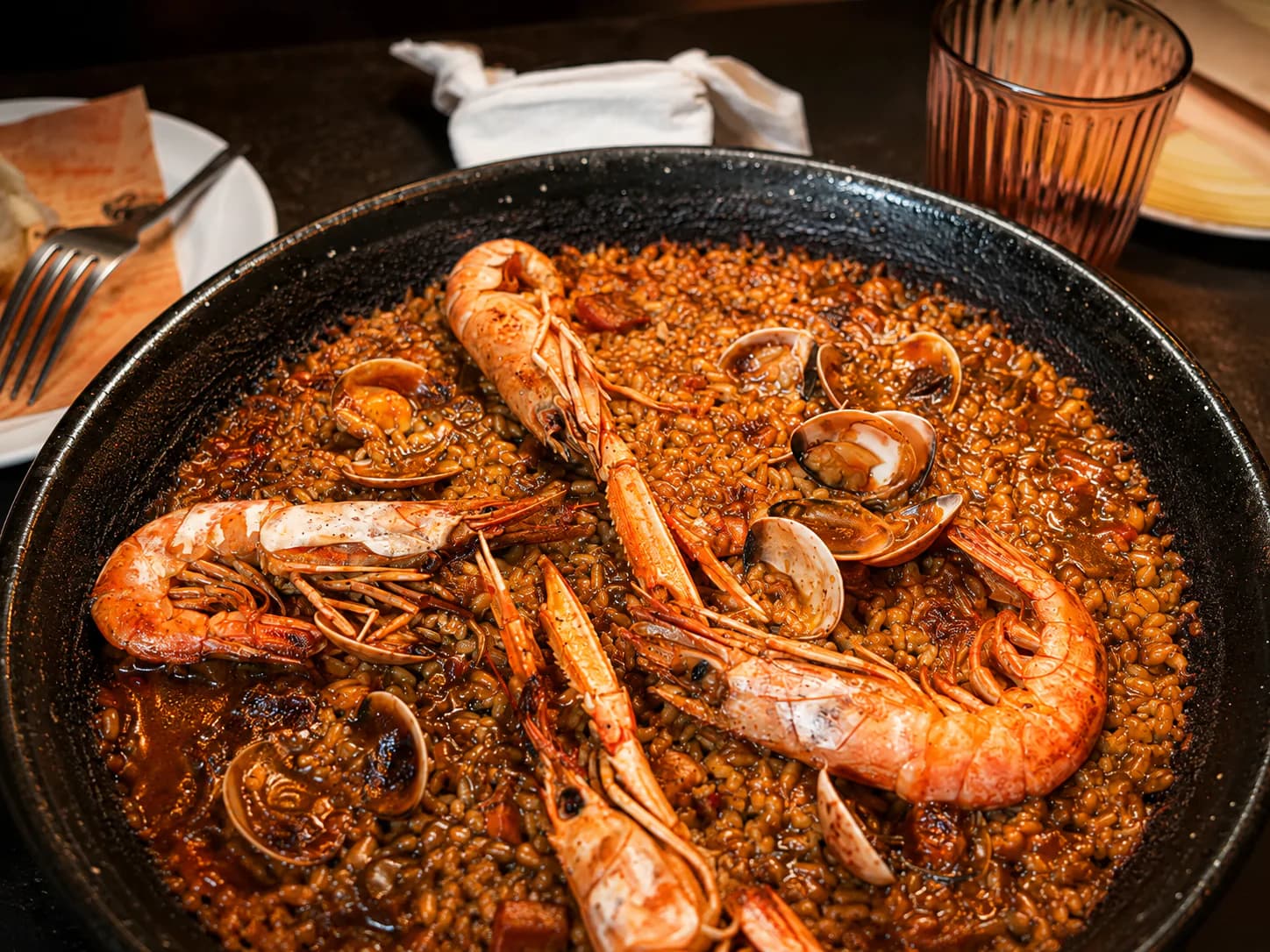
Paella de marisco
Seafood paella recipe
A seafood paella recipe for four with bomba rice, prawns, squid and mussels, a tomato sofrito and practical advice on stock, even heat and socarrat.
- Serves
- 4 servings
- Prep
- 20 minutes
- Cook
- 45 minutes
- Rest
- 5 minutes
- Total
- About 70 minutes
Before the pan goes on
Use a shallow 38–40 cm pan with heat covering its base, plus a saucepan for stock, a lidded saucepan for mussels, a measuring jug, scales, tongs and a food thermometer. A small burner beneath a large pan can leave the outside rice hard; two smaller evenly heated pans are a better option. Divide the ingredients between them.
Timings are estimates. Rice brands, seafood size, your pan and evaporation can change them; follow the rice packet and check doneness. Start with fresh or fully fridge-thawed raw prawns and squid. Thawing, usually overnight, is additional. See the FDA’s seafood guidance.
The shopping list
Ingredients for four
- 400 g dry bomba rice
- 1.2 L fish or shellfish stock, plus 150–200 mL extra stock for adjustments, all kept hot; use low-salt stock
- 300 g cleaned raw squid or cuttlefish, cut into 2 cm pieces
- 300 g raw peeled, deveined prawns (weight after peeling)
- 500 g live mussels, scrubbed and debearded
- 4 tablespoons olive oil (60 mL)
- 1 medium onion, finely chopped
- 1 small red pepper, finely diced
- 2 garlic cloves, finely chopped
- 2 medium ripe tomatoes, grated, skins discarded (about 200 g tomato flesh)
- 1 teaspoon sweet paprika
- 1 small pinch saffron
- Salt, as needed, and lemon wedges to serve (optional)
Contains crustaceans, molluscs and, with fish stock, fish. Check stock labels for other allergens.
From chopping board to table
How to make paella, step by step
Get everything ready
Allow about 20 minutes to prepare the ingredients. Discard live mussels with cracked shells and any open ones that do not close when tapped. Chop the vegetables and seafood. Heat the measured stock, then steep the saffron in a little of it. Keep the prawns chilled until needed. Wash hands, utensils and boards after handling raw seafood.
Steam the mussels separately
Put the mussels in a lidded saucepan with a splash of water. Steam until their shells open, usually about 5–8 minutes; discard any that stay closed. Set the cooked mussels on a clean plate while you finish the rice. This can run alongside the next step. Do not add the mussel cooking liquid to the paella: the stock quantity is already measured.
Build the tomato base
Heat the olive oil in the paella pan over medium heat. Cook the squid for about 4 minutes, then add the onion and pepper and soften for about 8 minutes. Stir in the garlic for 1 minute. Add the grated tomatoes and cook for another 7–8 minutes, stirring, until the mixture is thick rather than watery. This cooked-down base is the sofrito.
Add the rice and hot stock
Stir the dry bomba rice into the sofrito for 1 minute. Lower the heat, add the paprika and stir briefly, about 15 seconds, then immediately pour in the 1.2 L hot stock, including the saffron infusion. Taste the broth and add salt only if needed. Spread the rice evenly once and bring to a lively simmer. Keep the extra stock hot. From here, stop stirring.
Cook the rice and add the prawns
Allow about 18–20 minutes for the rice, checking its packet. Simmer uncovered, briskly and evenly, for the first 5 minutes, then reduce to a gentler steady simmer. With about 6–8 minutes remaining, arrange the raw prawns on top; add the cooked mussels near the end to heat through. Check the largest prawn reaches at least 63°C / 145°F and is firm and opaque; a timer alone is not enough. Taste the rice: it should have a little bite, with no chalky centre. If it is hard and the pan is dry, add 50–100 mL reserved hot stock and continue gently until cooked. Do not stir.
Try a little socarrat, then rest
Once the rice and seafood are cooked and no free liquid remains, you can raise the heat slightly for 30–60 seconds to encourage a lightly toasted base, or socarrat. Stop at a gentle crackle and toasted aroma; smoke or an acrid smell means stop immediately. This part is optional. Turn off the heat and rest for 5 minutes before serving with lemon, if you like. If loosely covering the pan, do so off the heat and keep cloths away from flames.
For the shell checks and cooking temperature above, see the FDA’s seafood safety advice. The no-stir method and rest draw on Montsià’s paella technique; the timings are an adaptation for this recipe.
A little context, now dinner is underway
Where the Catalan angle comes in
Paella’s roots are Valencian. Traditional paella valenciana generally brings together chicken, rabbit and beans; seafood paella is a different version. Visit València explains that distinction. Barcelona does not need to claim the invention to enjoy a good rice dish.
This version takes inspiration from Montsià’s seafood recipe, published by a rice producer in Catalonia’s Delta de l’Ebre. Its seafood, grated tomato and onion offer a useful coastal starting point. The onion and pepper here are a home-style choice, rather than a rule that every Spanish cook must obey. I’ll leave the national arguments to someone whose dinner is already cooked.
Visiting Barcelona? Our guide to what to eat in Barcelona covers rice dishes, tapas and how to order.
Rice, stock and the important bits
Paella questions, answered
What rice should I use for seafood paella?
Use bomba for this recipe. Other Spanish rice varieties can work in their own recipes, but they may need different liquid amounts and cooking times. Long-grain, sushi and risotto rice are not interchangeable with bomba in this method. Check the packet rather than assuming every bag labelled “paella rice” behaves the same.
What is the rice-to-stock ratio?
Start with 400 g dry bomba rice and 1.2 L hot stock, with another 150–200 mL held back. That is 3 mL stock per gram of dry rice, not a 3:1 ratio measured by cups. Pan size, heat and evaporation change what you need. If the rice is still chalky when the pan dries, add a little reserved hot stock and keep simmering.
Can I make paella without a paella pan?
A wide, shallow frying pan can work if its base is heated evenly and the rice stays in a shallow layer. For this four-serving recipe, plan around a 38–40 cm pan with a suitably broad heat source. If your hob only heats the centre, use two smaller evenly heated pans and split the ingredients. A deep saucepan changes the method; a bigger pan on a tiny burner does not fix it.
How do I get socarrat without burning the rice?
Wait until the rice and seafood are cooked and the liquid has disappeared. A brief rise in heat can toast the base; stop at a light crackle and toasted smell. Smoke and a bitter smell mean burning. Socarrat is optional, and a good plate of rice beats an impressive black crust. Never use this step to try to finish hard rice.
Can I use frozen seafood?
Yes, for the raw prawns and squid: thaw fully in the fridge, drain and pat dry before starting, following the package instructions. Thawing time is extra. A pre-cooked seafood mix needs different cooking instructions; do not use the raw-prawn timing unchanged. This recipe’s shell checks apply to live mussels.
Can I double the recipe?
Use two evenly heated pans, or a suitably larger pan and heat source. Doubling everything in the same pan deepens the rice layer and changes evaporation, so the stated timing and stock guidance will no longer be reliable.
The starting stock quantity draws on chef Mireia Carbó’s bomba advice. It is a starting point, not a universal ratio. For another home-kitchen approach to rice, pans and troubleshooting, see RecipeTin Eats’ paella guide.